


Blogger’s Note: I’m still responding to Bill Ferriter‘s post: “I’m Not Google Certified. Does That Make Me a Bad Teacher?” Here was my December, 2018, Part I response. The following is Part II in a mini-series of responses [End Blogger’s Note].
The Big Picture
By now, you know how it works. Of the seemingly 145 apps, programs, and gadgets launched every week, many approach our learning spaces, and some make it in. With good intentions, educators can’t wait for another opportunity to make teaching and learning better for kids. Also excited to earn the accolades and swag, educators begin the Ambassador journey.
Exploitation? There’s a Million Apps for That
These educators are so ready to associate their professional identity and self-worth with the vendor, that they subconsciously do its’ marketing research, advertising, trouble-shooting, sales, and promotions for FREE. We’re potentially talking about hundreds of FREE hours.
By the way, I’m one of these educators.
If I fully vet any vendor to discover that: they’re in it for the right reasons; they respect educators and value their feedback; they might even be former educators themselves; their products and services are appropriate, legal, and district-approved; and their stuff can be aligned with standards, then I’m willing to go further.
I’ve been strongly advised that I should no longer be doing so many things for free, but I just can’t help myself. The recognition feels good, because I don’t get that from too many other places. The t-shirts and stickers look sharp. I’ve already thought about where to post the badges on my professional portfolio. I’d include my titles in all of my social media bios, but mostly because I want others to know that they can contact me for advice. And any association with popular vendors might double as resume boosters. But it’s still about the kids–and their learning– right?
And if educators do earn money from vendors, the challenge now lies in conflicts of interest in their own daily learning spaces. Will they force an app on their learners even if it’s not appropriate for their age, curriculum, or particular topic because they’re being paid by that vendor (or even by an implication that they may one day be paid by that vendor), or will they do what’s right by kids–always–no matter what?
Here’s the Thing
Even though I get all of this, I’m still not sure that this edu-marketing relationship is a problem in education. You see, I don’t want to drive away any vendor reading this post. In fact, just the opposite–I’m brainstorming how we can work better–together.
Where We Are
The vendors get what they want from educators–who do a TON of heavy lifting for them. I often think of this game in terms of football. Companies get the crowd fired up, receive the kickoff, and take the ball to the 50-Yard-Line. And then their part is done. They got what they needed. But we’re only halfway home.
You see, it’s up to educators to take the ball from the 50-Yard-Line to the end zone, which is where growth and learning will be scored. After all, the goal is to enhance learning experiences in meaningful ways. If educators miss this, they might as well just punt.
Rerouting the Ambassador Journey
The beginning and middle of the ambassador journey are what they are:
- I know everything about an app.
- I’ve earned the Ambassador, Certified, or Guru (of sorts) title.
- I can tell adults everything about the app.
But none of these make me a good or better teacher, that is, unless we finish the course; unless we take the ball from the 50-yard line to the end zone. Therefore, it’s up to US to continue earning the title by:
- Transferring ambassador journey knowledge to our learners in meaningful ways.
- Proving how kids’ learning was specifically enhanced by that tool, app, or program.
- Communicating value of any resource in terms of specific learning outcomes.
Win-Win What-Ifs to Make the Ambassador Journey Better
What if companies, vendors, and third-parties:
- Researched specific standards learned in the classroom, and marketed around those? Educators, PTAs, and third-party donors need to know a tool can enhance standards-based learning. They need to see immediate purpose and relevance.
- Approved their products through our school systems and districts for us, so educators didn’t have to invest extra time in research and investigation.
- Knew how students can access single sign-on platforms, and understood our need for–and their role in–creating single approval platforms. What if the other side worked more cleverly to help school systems?
What if educators:
- Posted three video examples of how the app enhanced standards-based learning in their space before earning the Ambassador title?
- Posted how the app was enhancing learning and not just about having fun? (Ideally, both are preferred, right)?
- What are your thoughts on this google slides example and this Flipgrid example:


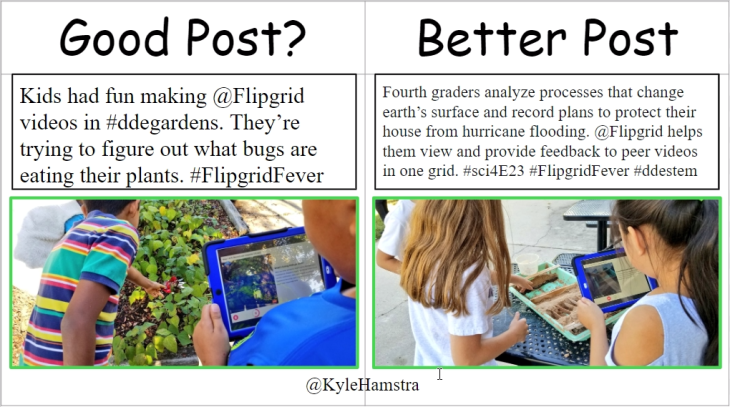

I’m still thinking on these processes, and how we can work together to make teaching and learning better, in the right ways, and for the right reasons. Part III coming soon…
Vendors take educators to the 50-yard-line. That's it. That's all they need. They got us doing advertising and marketing research for FREE, so that we can feel good about having a badge (I'm a proud #googleCE, btw). But that's it. They got what they wanted… 1/2 #tnedchat
— Kyle Hamstra (@KyleHamstra) November 28, 2018
If educators don't demonstrate follow-up, follow-thru, application, extension with their certs, badges, micro-credentials, ambassadorships, then what have we really learned? How have our students really benefited? What if these were starting lines–not finish lines? #tnedchat
— Kyle Hamstra (@KyleHamstra) November 28, 2018
These @MrsAyresTweets 4th gr Ss go outside to learn #googleslides. No. Instead: Learners research changes in an organism's environment that can be beneficial or harmful, & #googleslides was a tool that made archiving, sharing, collaboration, & publishing easier. #sci4L11 #ddestem pic.twitter.com/QnOQxnyVkB
— Kyle Hamstra (@KyleHamstra) September 25, 2018
We're not learning how-to-merge-cube. Rather, first graders use #mergecube to simulate Hawaiian landforms, learning how to summarize physical properties of earth materials & express length of an object with smaller, same-size units. #sci1E21 #math1MD2 #ARVRinEDU #SwimFwd #ddestem pic.twitter.com/nXi0xNvpNz
— Kyle Hamstra (@KyleHamstra) May 15, 2018
"We don't have to get a million diff digital tools to do diff things in the classroom. We can use the same tools, but in different ways. And #googleslides is my favorite example of that. Google Slides gives you design freedom and ability to collaborate." @jmattmiller #HiveSummit
— Kyle Hamstra (@KyleHamstra) August 5, 2018